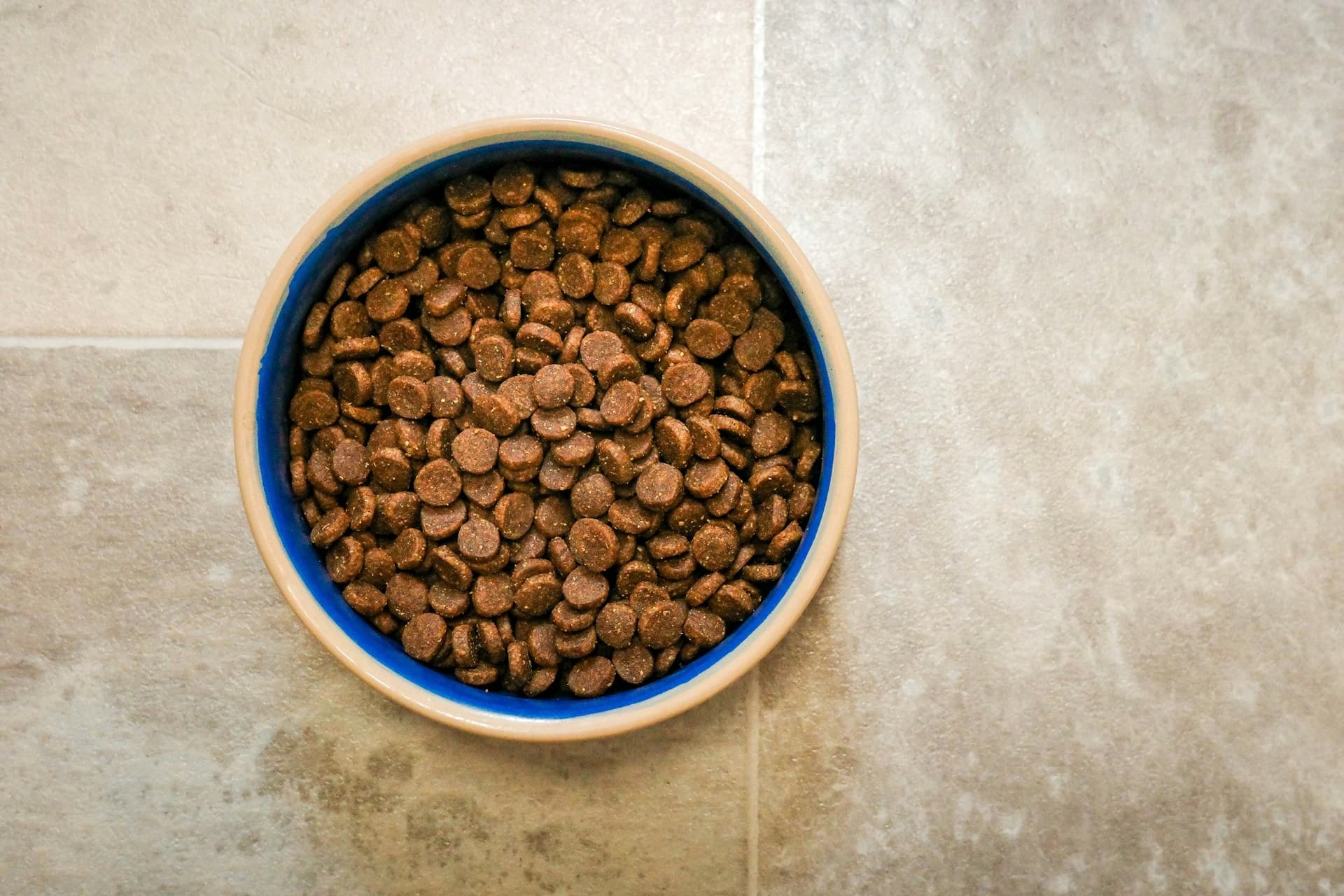
A pet food maker is preparing a new premium dry food for adult dogs. The marketing team wants a higher meat share and more fat for a glossier coat. The nutritionist prepares the formula and the crude protein on the label stays the same as the previous product. But because fat has gone up, so has the energy of the food. When the formula is checked against the FEDIAF profile, protein turns out to be much closer to the limit than expected.
Dogs eat by energy, not by percentage
Under healthy conditions, cats and dogs eat until they have met their energy needs. Owners also usually feed by the feeding guide on the pack, which means by energy. Fewer grams of a higher-energy food are fed. So the amount of a nutrient in each gram of food is not enough information on its own. What matters is how much protein, minerals and vitamins the animal gets while meeting its daily energy need.
That is why the FEDIAF nutritional guidelines give nutrient recommendations both per 100 grams of dry matter and per 1,000 kcal of metabolisable energy. The dry matter values are calculated assuming a certain energy density. When a food's energy is above that assumption, looking at the dry matter value is misleading and the value per unit of energy should be used.
An example
The numbers are illustrative. For the real minimums, check the current edition of the FEDIAF guidelines. Our old food contains 3,500 kcal of metabolisable energy and 22 percent crude protein per kilogram. That is 220 / 3.5, about 63 g of protein per 1,000 kcal. Because fat has been raised, the new food contains 3,900 kcal per kilogram, with crude protein still at 22 percent. Protein per 1,000 kcal is now 220 / 3.9, about 56 g.
Although the label has not changed, the dog's daily protein intake has fallen by about 11 percent. In a food made for a dog with little activity and a low energy need, that gap can push protein below the minimum. The same goes for minerals, vitamins and amino acids. In every formula where fat is raised, the other nutrients need to be checked again per unit of energy.
Which equation did you use for energy?
One difficulty with working per unit of energy is that a food's energy is not measured directly but estimated with an equation. Two approaches are common. Modified Atwater factors use fixed energy values for protein, fat and carbohydrate. The NRC 2006 equations start from gross energy and estimate digestibility from crude fibre.
The two methods can give different results for the same food. In a highly digestible premium food, modified Atwater factors usually underestimate energy. In our example, if the food calculated at 3,900 kcal with Atwater comes out at 4,100 kcal with the NRC equation, protein per 1,000 kcal drops from 56 g to about 54 g. In a formula close to the limit, that difference can turn a food that looks compliant into one that is not. So it matters to know which equation was used and to leave a safety margin for values near the limit.
Then there is the label arithmetic. The feeding guide on the pack is based on the food's energy. If energy has been underestimated, the guide tells owners to feed more than the dog needs, which leads to weight gain over time. If energy has been overestimated, the dog is underfed. So the energy estimate decides not only nutrient adequacy but also the amount the owner puts in the bowl every day. A simple feeding trial with a few dogs before a new product is launched shows whether the amounts in the guide are realistic.
A cat is not a dog
Cats are obligate carnivores and have different needs from dogs. Their protein requirement is higher, they cannot make enough taurine themselves, and they need arachidonic acid and vitamin A in preformed form. Adapting a plant-based dog food formula for cats is therefore not a simple change of proportions.
Puppies and kittens need special attention too. During growth, energy, protein and mineral needs are higher than in adults. In large-breed puppies, both a minimum and a maximum for calcium matter. Excess calcium is associated with skeletal development problems in fast-growing large breeds. So in puppy foods, the calcium to phosphorus ratio and the total calcium level should be limited together.
The limits of extrusion
Dry foods are made by extrusion, and the formula has to fit production conditions as well as nutritional requirements. A certain starch level is needed for kibble expansion and structure. Part of the fat is added as a coating after extrusion, and there is a limit to how much fat can be coated. Very high meat and fat levels can cause problems in the extruder and make the kibble fall apart.
Palatability is a constraint too. Cats in particular are very sensitive to the smell and texture of their food. A food that is perfect on paper but that the animal will not eat is of no use. That is why palatant and coating fat levels are often fixed in the formula and the other ingredients are worked out around them.
Solving the formula per unit of energy
OptiFormula lets you formulate dry and wet foods that meet FEDIAF profiles together with protein, fat, digestibility and extrusion limits. Nutrient ratio equations make it possible to limit nutrients per unit of energy and to keep ratios such as calcium to phosphorus in every solve. When the fat or meat share changes, the adequacy of the other nutrients per unit of energy is then checked automatically.
A pet food label always speaks in percentages, but cats and dogs eat by energy. Solving the formula per unit of energy turns the values on the label into the nutrients the animal actually receives.