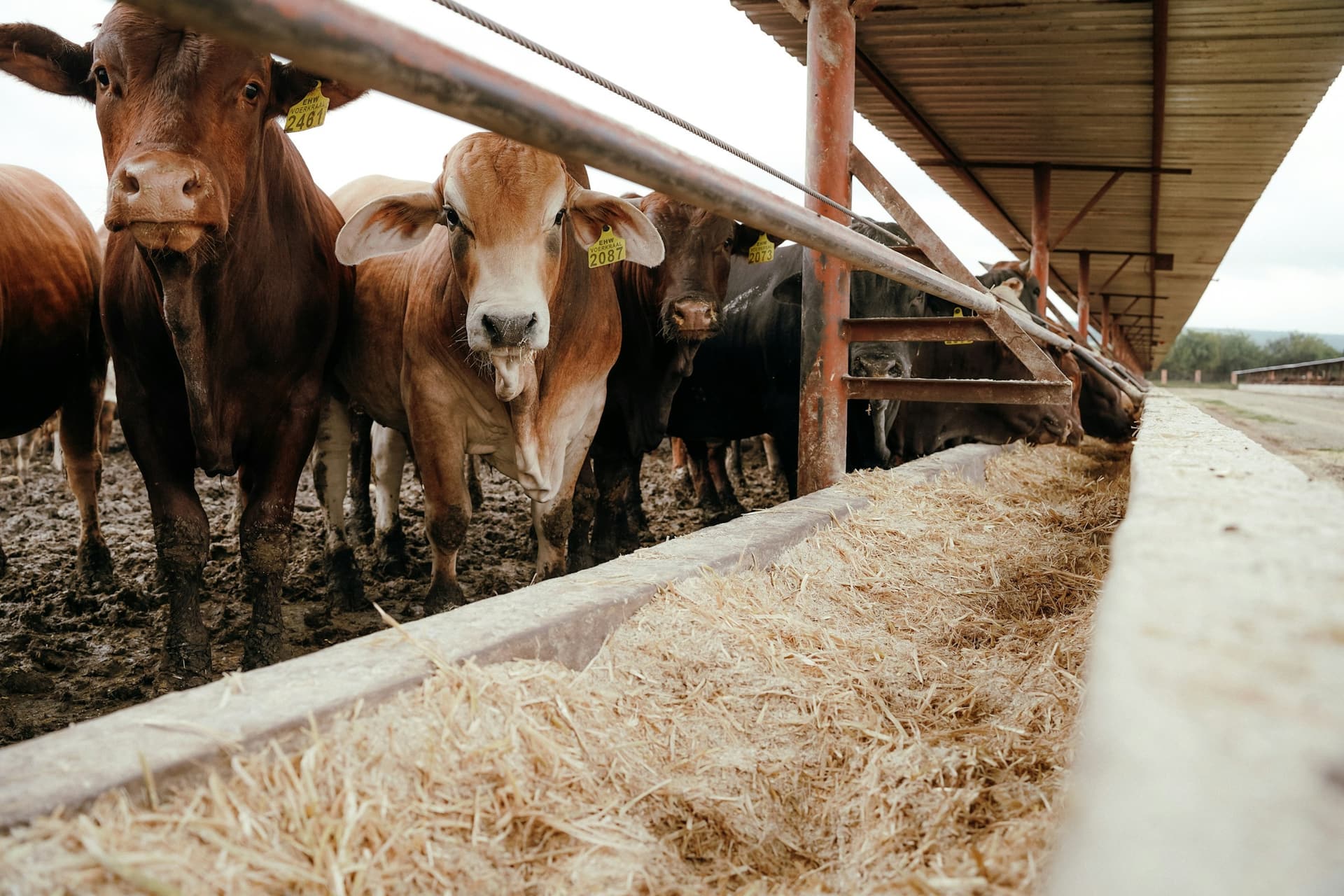
A feedlot buys calves at around 350 kg and feeds them to 600 kg. Feed prices have risen, so the owner wants a cheaper ration and asks the consultant to cut the concentrate share a little and use more straw and silage. The daily feed cost falls. A few months later, when the numbers are done, it turns out the animals reached slaughter weight later and the cost per kilogram went up, not down.
The right yardstick: cost per kilogram of gain
In beef production, the value of a feed is measured by the gain it delivers. A ration that is cheaper per head per day produces a kilogram of gain more expensively if it lowers daily live weight gain noticeably. On top of that, the longer the feeding period, the more daily fixed costs such as housing, labour, veterinary care and financing add up.
Take an example, with illustrative numbers. Ration A costs 85 TRY per head per day and gives a daily gain of 1.4 kg. Ration B is higher in energy, costs 95 TRY a day and gives 1.6 kg. Looking at feed cost alone, a kilogram of gain costs 85 / 1.4, about 60.7 TRY, on ration A and 95 / 1.6, about 59.4 TRY, on ration B. Ration B, the more expensive one per day, is already cheaper per kilogram.
Add 15 TRY a day of fixed costs and the gap widens. On ration A a kilogram of gain costs (85 + 15) / 1.4, about 71.4 TRY, and on ration B (95 + 15) / 1.6, about 68.8 TRY. For a 250 kg feeding period, the difference is about 670 TRY per head. On ration B the animals reach slaughter weight about 22 days earlier, which means more animals fed in the same pens each year.
That does not mean the densest ration is always the best. As energy density rises the ration gets more expensive, and beyond a certain point the extra gain no longer covers the extra cost. The right point depends on the animals' genetics, age and sex and on feed prices. What matters is to compare rations by cost per kilogram of gain, not by price per tonne.
Getting requirements right
To know whether a ration will deliver the expected gain, the animal's energy and protein requirements have to be worked out correctly. They depend on live weight, target daily gain, breed and mature weight, sex and environmental conditions. For beef cattle, models such as NASEM 2016 handle these variables together and help predict what gain can be expected from a given ration.
Early-maturing and late-maturing breeds have a different body composition at the same weight. An early-maturing breed lays down a large share of its gain as fat at 500 kg and needs more energy per kilogram of gain. So the same ration gives a different gain in the two breeds. Solving the ration separately for each group of animals is the way to account for that difference.
Measuring the gain actually achieved matters as much as predicting it. Weighing animals at entry and at set intervals shows whether the ration is delivering the expected result. If the gap between predicted and actual gain persists over several weighings, either intake differs from what was expected or the feed values do not reflect reality. That gap is the most valuable information for correcting the ration.
Stepping up to concentrate
High-energy rations can deliver cheaper gain, but the rumen has to be adapted to them gradually. In an animal coming off pasture or a forage-based ration, the rumen microbes are not yet able to ferment starch quickly. A sudden change lowers rumen pH and leads to acidosis. Acidosis sometimes shows up as obvious illness, but more often as swings in feed intake and poor performance.
In practice, the step-up is run as a programme of several steps. At each step the concentrate share is raised a little and the animals stay on that step for a few days. A drop in intake, changes in manure consistency and cases of lameness are signs that the step-up is going too fast. Even the final ration should contain a certain amount of physically effective fibre for rumen health.
Water, bunk space and observation
However good a ration is on paper, two things decide the result in the pen: whether the animals can eat enough feed and whether they can reach clean water easily. If bunk space is short or the bunk sits empty during the day, dominant animals eat too much, timid ones too little, and large differences open up within the group. When water intake falls, feed intake falls with it.
Checking regularly how empty the bunk is in the morning is the simplest way to adjust the amount fed to intake. If the bunk is completely empty every morning, the animals could eat more. If a lot of feed is left, there is waste or the animals are sorting the ration.
Seeing the ration with its economic result
OptiFormula TMR calculates requirements for beef cattle in its cattle module with models such as NASEM 2016 and NRC 2007. Each ration shows dry matter intake and daily cost per head, forage and silage analyses are kept together with the feed library, and a mixer wagon loading list is prepared from the approved ration. Solving rations at different energy levels side by side and judging them against the expected gain makes it easier to compare the cost per kilogram of gain.
The feedlot's question is always the same: how do I bring this animal to slaughter weight at the lowest total cost? That question is answered not by the ration with the lowest price per tonne, but by the ration with the lowest cost per kilogram of gain.